
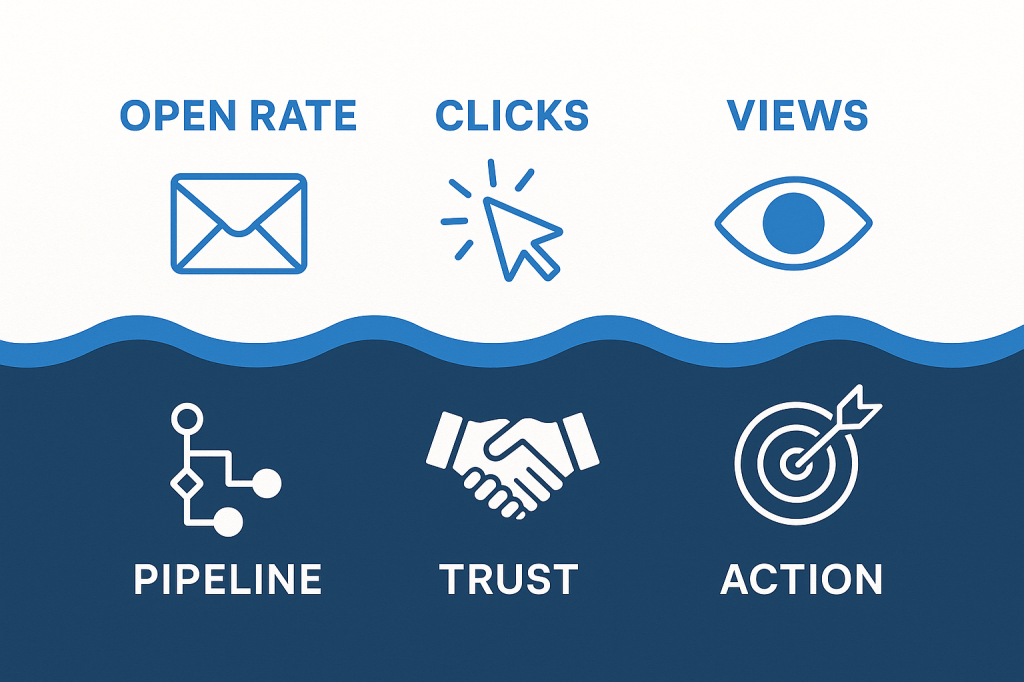
Your campaign just pulled a 35% open rate. Great. But how many of those opens turned into real movement? How many clicked with purpose? Booked a call? Shared it with their team? Used your message in their internal pitch? That is the part open rate will not tell you.
Open rate gives the illusion of momentum. But illusion does not close pipeline. Movement does.
Why Open Rate Feels Safe and Why It Is Failing You
Marketers still anchor to open rate because it is easy to access, fast to report, and visually rewarding. But that does not make it meaningful. Apple’s Mail Privacy Protection made tracking less reliable, but that is only the start. The real issue is deeper.
Here is what you are dealing with:
- False opens from security filters that scan your message before a human ever sees it.
- Passive behavior where people open out of habit, not interest.
- Client inconsistencies that make tracking uneven and unreliable.
- Dark funnel activity happens in unseen places. Buyer influence lives in peer DMs, Slack threads, and internal conversations. These are places you will never see on a dashboard.
When you treat open rate as your primary measure of success, you are not just looking at outdated data. You are asking the wrong question.
Because what you should be asking is:
- Did this message move someone meaningfully closer to a decision?
- Open Rate Optimizes for Attention, Not Action
The moment open rate becomes your north star, the focus shifts from clarity to cleverness. Subject lines become clickbait. Urgency replaces substance. You optimize for opens, not outcomes.
But what happens after the open matters more. If your audience does not click again, does not explore more, does not engage deeper – you have sparked a glance, not started a journey.
What to Track Instead: Metrics That Signal Real Movement
If open rate is no longer your headline, where should your focus shift? Here are the signals I use when I want to know if a campaign is actually doing its job:
Time to Action
How fast do people take the next step after receiving the message? Fast action signals clarity. It means the value was immediate and the friction was low.
Second Click Behavior
First clicks show curiosity. Second clicks show trust. Are they exploring beyond the CTA? Watching the full video? Clicking into pricing pages or case studies? A second click is a quiet yes.
Sales Echoes
If your campaign language shows up in discovery calls or sales emails without being forced, you have created resonance. That is not just engagement. That is adoption.
Pipeline Velocity
Did this campaign accelerate the path to a meeting? Did it help sales skip an objection? Are qualified leads moving through the funnel faster after exposure? That is where impact lives. Not in vanity spikes, but in velocity.
What If You Do Not Have Access to All These Metrics?
Not every team has full-funnel visibility. That does not mean you are stuck.
Start here:
- Use landing page dwell time as a proxy for second clicks.
- Gather informal sales feedback—even anecdotal quotes can reveal what is working.
- Set success criteria based on behavior, not just engagement. For example, “They clicked and visited three pages” is a better win than “They opened and deleted.”
And if your leadership still clings to open rate, bring them this: Opens do not close pipeline. But deeper engagement, faster conversion, and messaging that sticks do.
Ask Yourself: Are You Measuring the Right Momentum?
Before the next campaign report goes out, pause and run a quick check:
- Is this campaign showing up in how sales talks?
- Are we seeing deeper site engagement, not just single-click exits?
- Are we learning something that helps the next round perform better?
If the answer is no, it does not matter how good your open rate looks. That is not success. That is noise.
Final Thought
You are not here to chase clicks. You are here to create forward motion.
- Open rate is the shadow.
- Movement is the substance.
- Focus on what brings people closer, not what just gets their attention.
Because when your message shows up in conversations, shortens the sales path, and leaves an impression that lasts longer than the subject line, that is the metric that actually matters.



 My Ethos Lab
Leave a comment