
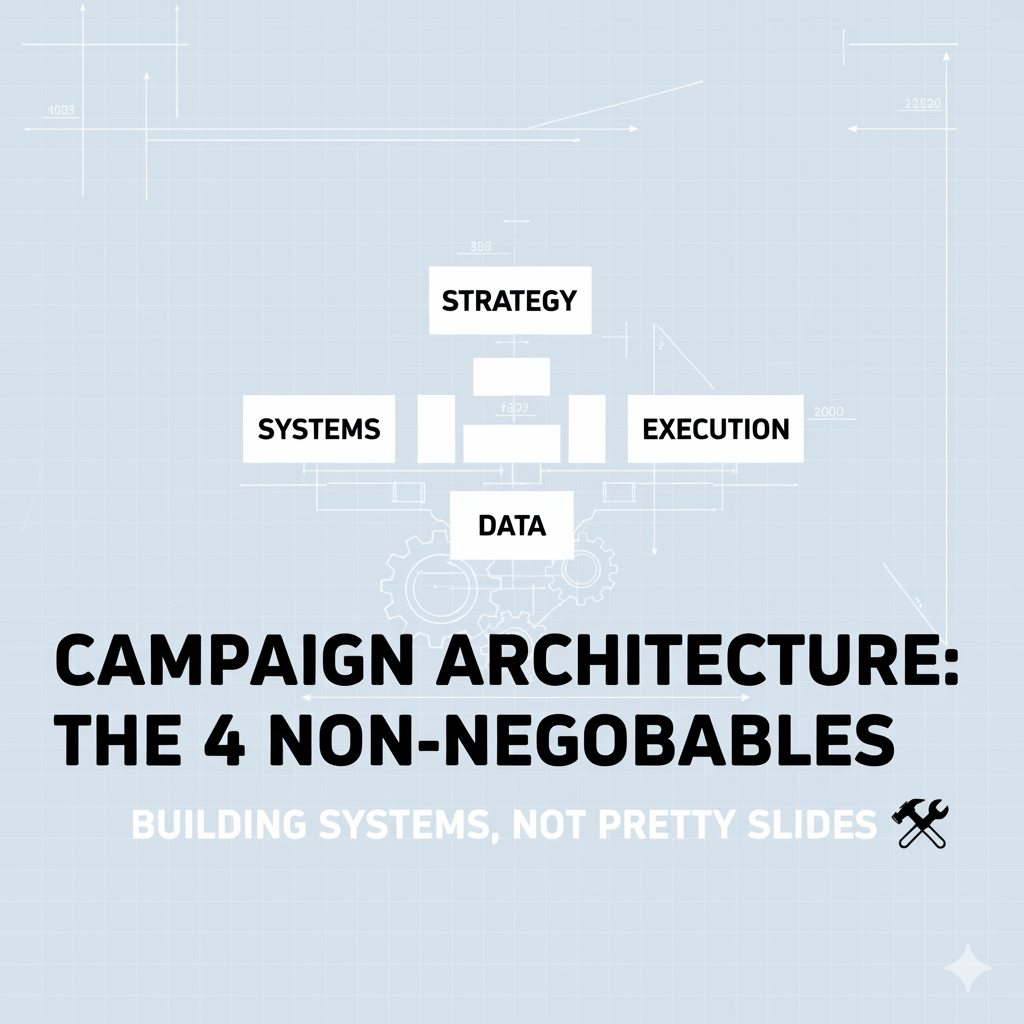
I’ve seen campaign architecture decks with 47 touchpoints across 12 channels that generated exactly zero qualified pipeline. Beautiful flowcharts, detailed persona maps, perfectly aligned messaging frameworks. Everything looked strategic until we measured what actually moved accounts forward.
The problem isn’t a lack of planning. The problem is that most campaign “architecture” is decoration for leadership meetings. Real campaign architecture isn’t about pretty diagrams or channel lists. It’s about building a system that moves accounts through a journey. It gives sales something they can use.
After running campaigns that worked (and plenty that didn’t), I’ve learned there are four non-negotiables every campaign needs. Skip any one of them, and you’re left with activity that looks strategic but doesn’t deliver.
1. Audience Definition That Goes Beyond “ICP”
An ICP deck in your shared drive isn’t enough. Architecture starts with segmentation tied to buying committees, intent signals, and conversion history.
- What doesn’t work: “Our target is mid-market SaaS CTOs.”
- What works: “The primary target is CTOs at 500–2,000 person SaaS companies. These companies show security intent signals. They have Q1/Q3 budget cycles. In vendor decisions, they also involve their CISO and VP Engineering.”
Make it actionable: Create a one-page brief. Include company traits, intent signals, and timing indicators. Identify the three-person buying committee for each target segment.
2. Messaging Hierarchy That Connects Strategy to Copy
High-level messaging frameworks rarely translate into copy that converts. Sales ends up improvising, emails sound generic, and your positioning gets lost.
A strong hierarchy includes your core narrative, three persona-specific proof points, and a one-sentence value prop SDRs can use in calls.
- What doesn’t work: “We help companies accelerate digital transformation.”
- What works: “We reduce security incidents by 60% without adding complexity to your infrastructure.”
Make it actionable: Build a messaging doc with your narrative at the top, persona proof points in the middle, and channel-ready copy at the bottom. Test the one-liner with sales before launch.
3. Channel Coordination That Accounts for Timing
Multi-channel isn’t the same as coordinated. Too often, campaigns blast everything at once, creating noise instead of momentum.
- What doesn’t work: LinkedIn ads, nurture emails, and direct mail all dropping the same week.
- What works: Awareness ads for two weeks, followed by LinkedIn content, then email sequences, with SDR outreach triggered by engagement.
Make it actionable: Map channels to buyer journey stages and set trigger-based sequences instead of “launch everything now.”
4. Feedback Loops That Force Realignment
No architecture survives contact with the market unless it’s built for iteration. Campaigns that work adapt quickly based on real buyer behavior.
- What doesn’t work: Monthly reviews focused on activity metrics.
- What works: Weekly checkpoints tracking conversions, SDR feedback on lead quality, and message testing that updates campaigns and conversations.
Make it actionable: Schedule weekly reviews with three agenda items: what’s converting, what’s not, and what we’re changing next week.
How to Measure Architectural Effectiveness
If your architecture is real, not decorative, it shows up in:
- Account progression: Are target accounts moving through funnel stages?
- Sales adoption: Is sales actually using your messaging and materials?
- Pipeline velocity: Do campaign opportunities move faster than average? Well-architected campaigns typically see win rates in the 5–20% range, depending on the business model (Factors.ai).
- Conversion benchmarks: Coordinated email campaigns often convert at 2–5% (Umbrex).
- Feedback quality: Are you learning things that improve the next campaign?
The Bottom Line
Campaign architecture isn’t a PowerPoint. It’s the difference between campaigns that generate activity and campaigns that generate pipeline. Miss one of these four elements and performance crumbles. Nail all four, and you turn strategy on slides into momentum in the market.




 My Ethos Lab