
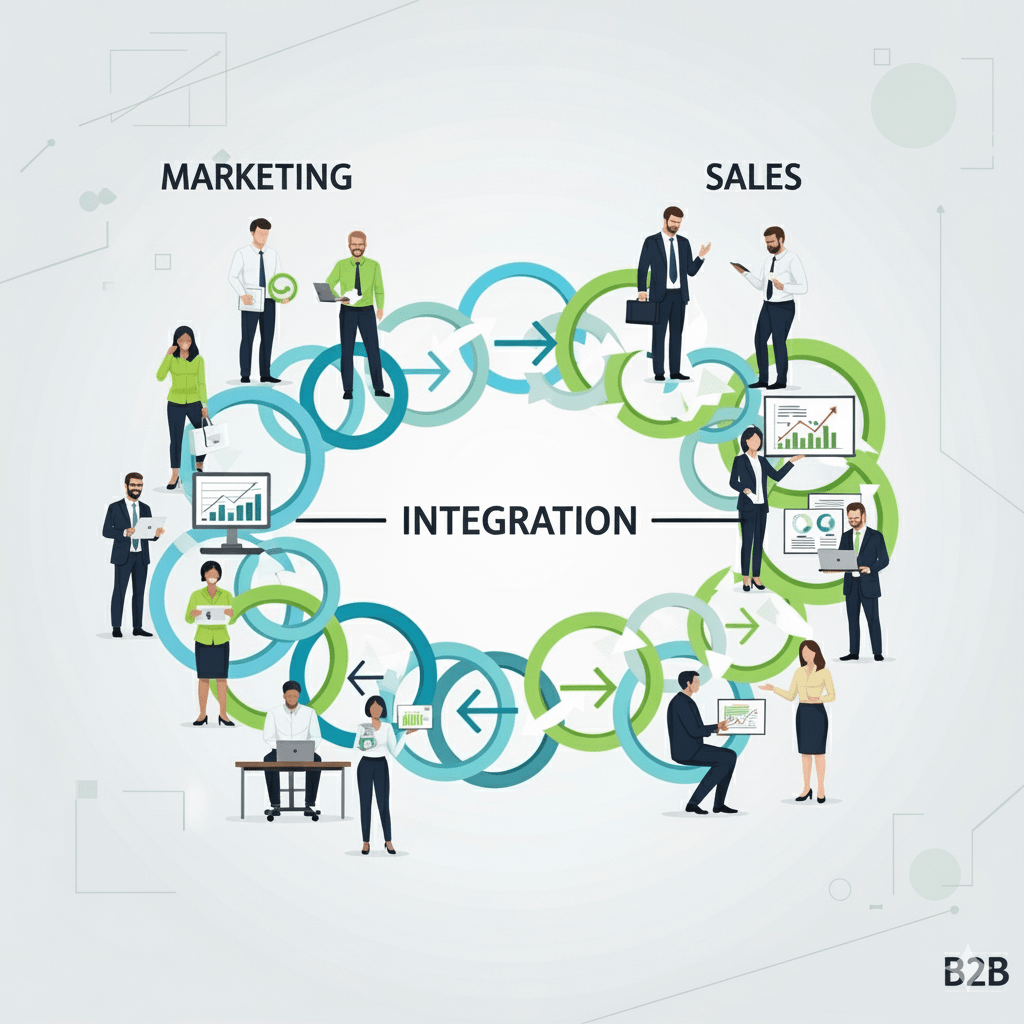
Everyone loves to talk about “alignment.” Marketing says the right things, sales nods along, and the deck looks great in the quarterly business review. But when campaigns go live, reality hits: marketing runs one motion, sales runs another, and everyone calls it “handoff.” That is not alignment. That is passing the ball and hoping it lands in the right hands.
The numbers tell the story. Research compiled by MarketingSherpa and DemandSage shows that around 79% of marketing leads never convert to sales (DemandSage). And according to Aberdeen Group, companies with strong sales and marketing alignment achieve 20% annual revenue growth, while those with poor alignment see a 4% revenue decline (Todd Hockenberry).
Integrated campaigns are supposed to solve this problem. They should create a connected journey from awareness to decision. But too often, they stop short by pushing leads into the pipeline and assuming sales will “pick them up.” The result is missed timing, inconsistent messaging, and wasted budget.
Here is the reality: campaigns don’t generate measurable pipeline impact until sales plays are embedded from the design phase, not bolted on afterward.
Why Traditional Handoffs Fail
The “handoff” model assumes buyers will wait while sales catches up. They won’t. A 2024 HubSpot survey found that 75% of B2B buyers prefer gathering product information on their own before speaking with a sales rep (HubSpot).
6sense research shows that buyers often spend about 70% of their buying journey doing independent research before engaging vendors (6sense).
By the time your rep calls, the buyer has already compared you to competitors. This creates the handoff gap – the 24 to 72 hour window when interest peaks and then drops fast if sales doesn’t step in with the right message at the right time.
What Effective Sales Plays Actually Look Like
A sales play is not “call once and log in Salesforce.” It is a structured, measurable sequence of actions tied to campaign triggers.
The anatomy of a high-performing sales play:
- Trigger Event
- Prospect engages with a webinar, playbook, or pricing page.
- CRM alerts sales in real time.
- Metric: Time from trigger to first touch (<24 hrs).
- Immediate Follow-Up (24–48 hrs)
- Tailored SDR email tied to the asset, not a generic template.
- Call or voicemail that extends the narrative.
- Metric: Response rate (15–25% vs. 2–5% cold outreach).
- Multi-Touch Cadence
- 5 to 7 touches over 2 weeks across phone, email, and LinkedIn.
- Messaging shifts: thought leadership → customer story → next step.
- Metric: Engagement rates (15–20% opens, 3–5% replies).
- Shared Content Assets
- Every touch connects back to campaign content, case studies, or tools.
- Reps extend the same story buyers already saw.
- Metric: Asset engagement and content journey progression.
- Exit or Accelerate
- Clear criteria: move back to nurture or into discovery.
- Automated workflows handle the transition so nothing slips through the cracks.
- Metric: Conversion to qualified opportunity (8–12%).
Joint Plays in Action
- Education Campaign: Marketing promotes cell-phone-free schools. SDRs follow with Siyata push-to-talk demos, showing how staff can maintain safety protocols without relying on personal devices.
- Healthcare Campaign: Marketing launches a data security message. SDRs send a security whitepaper, follow with a compliance-focused call, then share a hospital case study – all reinforcing the same story.
Why Companies Struggle
- Sales Adoption: Reps resist plays and go rogue. Solution: Pilot with top performers, prove results, then scale.
- Tech Gaps: CRMs and MAPs don’t sync.
- Solution: Integrate properly; the cost of broken handoffs is higher.
- Measurement Confusion: Teams track different KPIs.
- Solution: Align on shared leading (response, engagement) and lagging (pipeline, revenue) indicators.
Industry Nuance
- Enterprise Software: Plays span multiple stakeholders over 6–18 months.
- Professional Services: Plays prove credibility quickly with case studies.
- Manufacturing: Plays progress from problem identification to technical validation to ROI proof.
Measuring Success
Vanity metrics don’t cut it. Measure what actually drives pipeline:
- Leading: time to first touch, engagement, content progression, play execution consistency.
- Lagging: lead-to-opportunity conversion, velocity, deal size, CAC
The Competitive Advantage
This isn’t about theory or alignment decks. It is about a fundamental shift in how your teams operate. The companies winning today aren’t the ones with the flashiest campaigns or the loudest sales teams. They are the ones that preserve buyer momentum by connecting marketing attraction with sales progression.
Stop settling for a fragmented handoff. Build the play, run it, prove it, then scale it. Your pipeline depends on it.
Sources:
- MarketingSherpa / DemandSage: Lead Generation Statistics (DemandSage)
- Aberdeen Group via Todd Hockenberry: Sales & Marketing Alignment Research (Todd Hockenberry)
- HubSpot: What B2B Buyers Want in 2024 (HubSpot)
- 6sense: When B2B Buyers Reach Out to Sellers (6sense)




 My Ethos Lab