
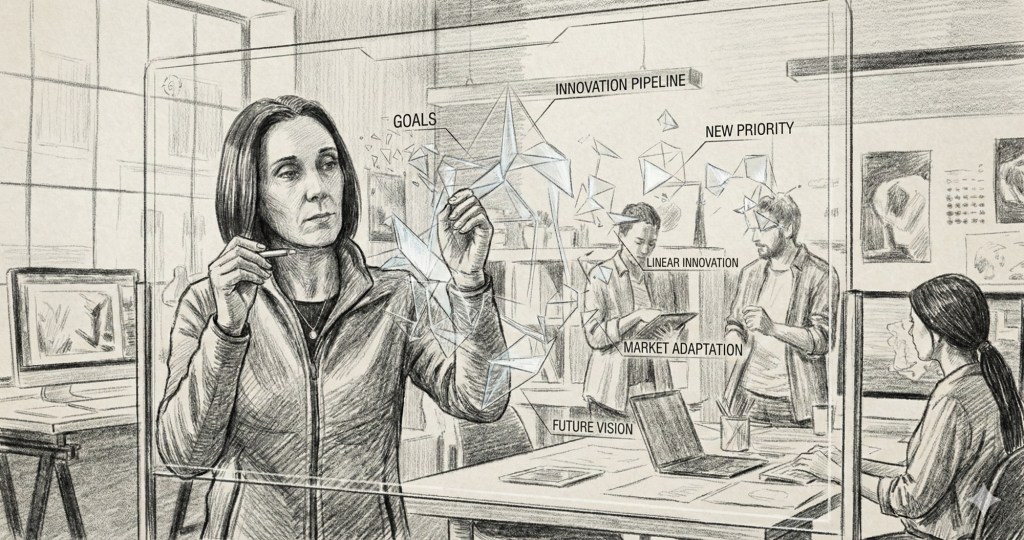
You line up the shot. Feet planted, shoulders square, breath steady. You have done this before.
The target shifts.
Not dramatically. Just enough. You adjust. Recalibrate. Breathe again.
It drifts.
And somewhere between the third adjustment and the tenth, you realize the problem was never your aim.
If you have ever felt like the priorities at work change faster than you can adjust, you are not alone. Shifting workplace priorities are becoming the norm, not the exception. The frustration many professionals feel rarely comes from a lack of skill. It comes from the exhaustion of constantly adapting to moving targets.
The data supports this. The World Economic Forum’s Future of Jobs Report shows that 44 percent of workers’ skills will be disrupted by 2027. When the environment evolves that quickly, even strong performers start questioning solid instincts.
Why Shifting Workplace Priorities Feel Personal
High achievers tend to look inward first. If results are inconsistent, the reflex is to assume something is wrong with the strategy or the execution.
Sometimes that is true. Often it is not.
If you are delivering consistent work but getting inconsistent outcomes, the issue is usually environmental volatility. The expectations around you are shifting faster than your execution window. It is not incompetence. It is instability.
This shows up everywhere: marketing, creative teams, operations, client services. You build a plan, align on priorities, then the market shifts or leadership moves in a new direction. The work is still good. The context simply moved underneath it.
Three Common Reactions To Shifting Workplace Priorities
When the workplace is unstable, high performers often fall into three traps:
1. Overthinking decisions
Your instincts feel harder to trust because the conditions keep changing. This is not a performance issue. It is a survival response to unclear expectations.
2. Trying to predict future shifts
Instead of executing the current plan, you plan for five possible scenarios. It feels strategic, but it creates scenario fatigue and drains focus from what matters now.
3. The paralysis of waiting
When priorities keep moving, pausing until things settle feels logical. In high volatility environments, settling never happens. Waiting for perfect clarity usually means the market moves while you stand still.
The Burnout Link: Recalibration Is the Real Drain
Burnout is often blamed on long hours or heavy workloads. The numbers tell a different story.
Research shows that 77 percent of workers have experienced burnout at their current job and more than 82 percent are at risk in 2024. Yes, hours and workload matter, but a large portion of burnout comes from resource constraints and communication gaps.
If you spend more energy figuring out what to do than actually doing it, the volatility becomes the real source of exhaustion. That distinction matters if you want to protect your energy and your performance.
How To Diagnose What You Are Actually Dealing With
To manage shifting workplace priorities effectively, you need to diagnose the challenge accurately.
Performance challenges look stable.
Patterns repeat. You know what needs refinement. Skill development or process improvements solve the problem.
Environmental volatility shows up differently. You will see:
- Inconsistent results from consistent effort
- Feedback that shifts because the target moved, not because your work declined
- Priorities that change before earlier initiatives mature
- A definition of success that moves faster than you can execute
When these patterns appear, the issue is the environment, not your capability.
A Simple Framework For Managing Shifting Workplace Priorities
Different problems require different strategies. Performance gaps need focused development. Volatility requires alignment, communication, and resource decisions.
Here is how to navigate the latter:
1. Diagnose the situation accurately
Is this a performance issue or an environmental one? Naming the volatility keeps you from internalizing chaos as personal failure.
2. Be selective with your effort
In stable environments, you can polish everything. In volatile ones, you prioritize ruthlessly. Some shifting priorities are glass balls and cannot drop. Others are rubber balls and can.
3. Ask for context, not just direction
When priorities change, understanding why they changed makes you a strategic partner, not an order taker. Context turns reaction into intention.
4. Invest where growth compounds
When specific project goals are unstable, focus on transferable skills. Strategy, data analysis, communication frameworks, decision making. Build capabilities that retain value regardless of how the current project shakes out.
The Strategic Advantage
When priorities keep shifting, your goal is not to chase every change. It is to navigate volatility with clarity.
The people who thrive in fast changing environments are not the ones who work the hardest. They are the ones who separate signal from noise and make confident decisions even when the ground is moving.
Key Takeaways
- Diagnose accurately: distinguish between performance issues and shifting workplace priorities.
- Protect your confidence: do not let unstable conditions undermine skills you know are strong.
- Choose strategically: not every shifting workplace priority deserves equal investment.
- Seek context: understanding why priorities change leads to better decisions.
- Focus on transferable value: invest in skills and capabilities that compound over time.

 My Ethos Lab