

Your expertise is invisible until you try to delegate it
Nate Jones recently wrote something that has been stuck in my head. His thesis was simple and more uncomfortable than it sounds: in the age of AI, the most important skill is not prompt engineering or technical literacy. It is delegation.
I am not talking about delegation as “handing tasks to someone else.” I mean delegation as the act of taking the judgment in your head and making it usable by something outside of you, whether that is a person, a system, or an AI agent.
AI is about to make visible something that has been invisible our entire careers. The marginal cost of producing drafts is collapsing, which means the bottleneck is no longer creating output. The bottleneck is selecting, shaping, and approving output, which is another way of saying: judgment.
If you can externalize that judgment, you scale. If you cannot, you become the cleanup crew for an infinite number of drafts.
The Hidden Trade We Have All Been Making
Here is what most marketing leaders have done for years: when you are juggling three campaigns, a rebrand, and stakeholder requests, it has been faster to do the work yourself than to explain your decision-making process to someone else. You can revise a deck quicker than you can articulate what “on brand” actually means.
So you do it yourself.
That has been a necessary survival tactic because agility matters. But there is a trade we rarely name: every time we optimize for immediate speed, we keep the expertise that drives that speed locked in our heads. We get faster at executing, but we also become the permanent go-to person for direction, approvals, and quality decisions.
That trade compounds. Revision loops multiply because “what good looks like” lives only in you . New team members ramp slowly because the real operating principles are tribal knowledge. Your calendar fills with review and cleanup. When you are out, decisions wait. When you get promoted, the team loses the operating system you never documented.
This is not a personal failure. It is what happens when expertise stays implicit.
Why Delegation Skills Are Becoming Essential
For most of our careers, the bottleneck has been execution capacity (more ideas than hands). AI is shifting the equation. Execution capacity is becoming abundant, which means the bottleneck is moving to clear direction.
The leaders who can articulate their expertise will scale in ways that were not possible before. They can delegate without drowning in revision cycles, develop people faster, and multiply impact across more initiatives simultaneously. The skill is not “using AI.” The skill is externalizing judgment so both humans and AI can execute at your standard.
The 4 Core Delegation Skills That Make Judgment Transferable
These four skills apply whether you are delegating to a teammate or to AI.
- Articulation: Making Invisible Expertise Visible When someone asks you to “write a nurture sequence,” your brain does not process those four words. It runs a bundle of variables automatically: voice, tone, level of specificity, and what must be avoided . Articulation is the practice of naming what you know, especially the assumptions you usually leave unsaid.
- Process Knowledge: The Decision Points Beyond the Steps SOPs capture steps, but process knowledge captures judgment . It is the “if-then” logic that determines when to adjust, when to pivot, and when to hold steady . Strong delegation requires documenting the decision tree, not just the workflow.
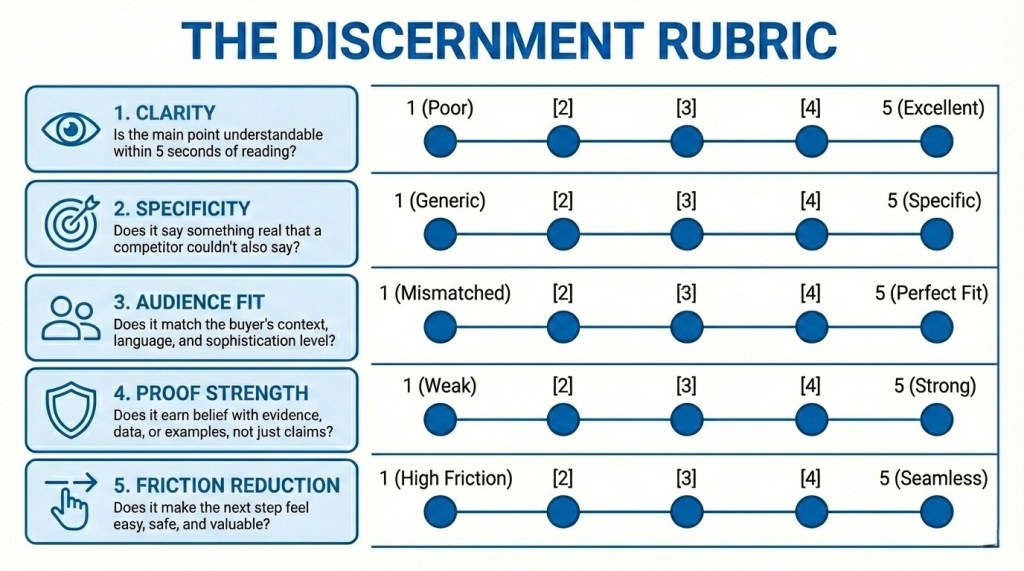
- Discernment: Quality Criteria That Scale Without You “I will know it when I see it” does not scale. It turns you into the approval gate for everything . Discernment means externalizing your quality rubric so someone else can apply your standards independently.
- Intent: The Strategic Context That Drives Decisions When you delegate without intent, you get work that meets the brief but misses the point. Intent is the “why” behind the work . It is what allows a person or an AI system to adapt correctly when reality changes.
Real-World Example: The “Decision Engine” Discovery
I while back I realized how much of my judgment was running on autopilot. I asked a junior marketer to brief a campaign using what I thought was a comprehensive template.
Three revision cycles later, the truth came out. The template captured the mechanics, but not the context I held automatically: budget flexibility, stakeholder dynamics, and the specific tone that works for that segment . None of it was documented. It was invisible until someone else tried to use my process.
As a Campaign Manager, you are not just executing. You are running a decision engine. AI is forcing us to show the full engine.
Practical Frameworks to Build These Skills
The Discernment Rubric Stop relying on vibes. For emails, ads, and landing pages, score each dimension from 1 (fails) to 5 (excellent):
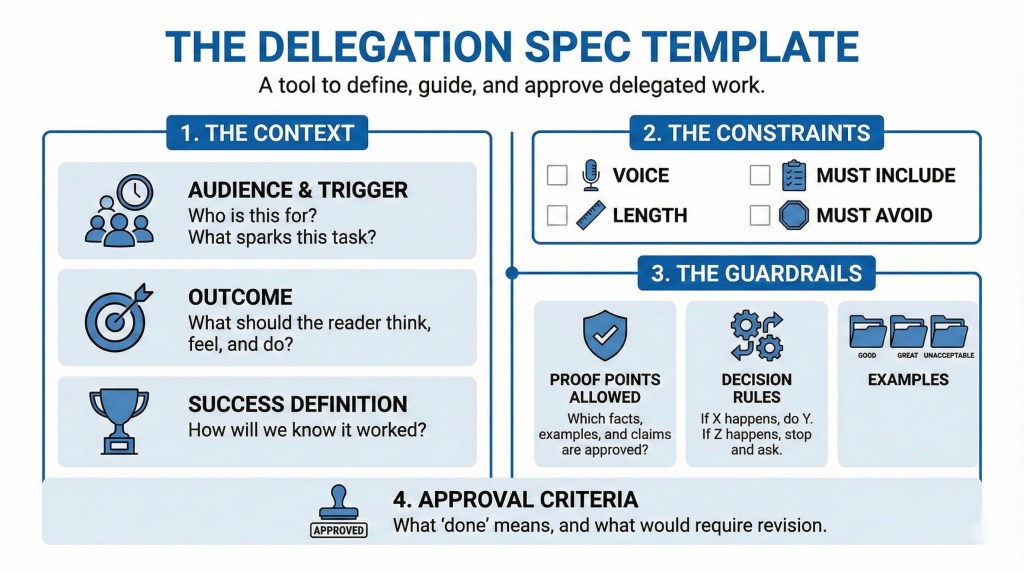
The Delegation Spec Template Use this structure for any repeatable deliverable:
FAQ: Delegation Skills and AI
What is effective delegation in 2026? It is making your judgment usable by something outside of you . It transfers decision criteria, not just tasks.
Why is this essential for AI? Because you can now generate infinite content. Without clear direction and a rubric for discernment, you will spend your entire day “cleaning up” AI output .
How do you delegate effectively to AI? Paste your full Delegation Spec into the prompt . Tell the AI to self-evaluate against your rubric before it gives you a draft.
What This Makes Possible
Execution is no longer scarce. Direction is. If you want to scale your impact, pick one process, make your judgment visible, and delegate it once this week. Use the rubric, refine the spec, then do it again.
That is how you turn expertise into leverage.




 My Ethos Lab