
Why the Skills That Built Your Demand Gen Career Are Exactly What Channel Needs
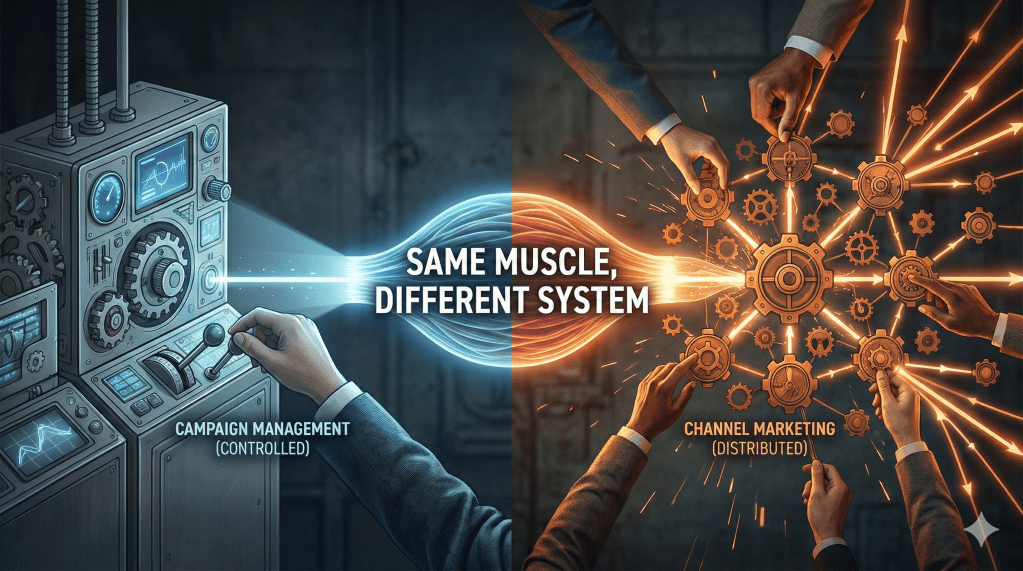
I have spent a lot of my career in campaign management (building multi-touch programs, tightening sequencing, watching conversion points, and improving handoffs). Channel marketing is not a departure from that work. It is the same muscle, applied to a different system.
But the system difference changes everything about how you use that muscle. If you do not understand the shift, you will keep building campaigns when what you actually need to build is an engine other people want to run.
Campaign Management vs. Channel Marketing: Controlled vs. Distributed
Campaigns are a controlled environment. You own the journey, the timing, the message, the channel mix, and the measurement. Even when it is messy, you still have levers you can pull directly.
Channel is a distributed environment. You do not run the journey; you enable it. You are not persuading one buyer; you are equipping a partner to persuade their buyer. You do not own the moment of truth. You influence it.
That distinction sounds simple, but it is not.
In campaign management, the job is performance. You are optimizing an engine you operate. In channel marketing, the job is adoption. You are designing an engine other people have to want to operate.
When you have spent years getting good at running the engine yourself, the instinct is to keep running it (tighter sequences, better creative, more sophisticated nurture tracks). But channel does not reward your ability to execute a perfect play. It rewards your ability to make someone else’s play easier.
How the Questions Shift
The strategic questions you are trained to ask still matter in channel. They just point somewhere different.
- Campaign mindset: What sequence will move a target account from awareness to action?
- Channel mindset: What kit and path will move a partner from interest to first revenue?
- Campaign mindset: How do we reduce friction in the funnel?
- Channel mindset: How do we reduce friction in someone else’s selling motion?
- Campaign mindset: What do we say to win attention?
- Channel mindset: What do we give them so they can win a deal?
The underlying logic is identical. You are still mapping a journey, identifying where momentum stalls, and removing friction at each stage. The difference is that your “conversion event” is no longer a form fill or a meeting booked. It is a partner taking action inside their own business on your behalf.
The “More Assets” Trap: Where Campaign Thinking Breaks
This is where most channel marketing efforts stall. In campaigns, more content usually helps (another nurture email, a better landing page, or a new case study). You are building a content engine that you control.
Channel does not work that way. Partners are not leads you are nurturing; they are operators you are enabling. The most common mistake is treating enablement like a content production problem.
More PDFs, more messaging decks, and more slide templates do not move the needle. The partner portal fills up, and adoption stays flat.
Research from The Channel Company’s 2025 State of Partner Marketing report found that the most effective vendor programs are not the ones producing the most content. They are the ones reducing friction in how partners access, customize, and deploy that content. Small and midsize partners especially ranked simplicity and personalized campaign planning support above sheer asset volume.
The partner does not need more information. The partner needs fewer steps, clearer proof, and a next action they can execute fast.
What Campaign Skills Actually Transfer to Channel
The good news is that almost everything you learned in campaign management transfers. You just have to redirect it.
Sequencing Becomes Enablement Architecture
In campaigns, you design sequences where touchpoint one leads to touchpoint two. In channel, you design enablement paths where onboarding leads to the first pitch, which leads to the first deal registration. The skill is the same: you are mapping a behavioral journey and making the next step obvious.
Conversion Optimization Becomes Friction Reduction
Campaign managers obsess over conversion rates between stages. In channel, the same obsession applies to partner behavior. Are partners completing onboarding? Are they accessing sales tools? Where does engagement drop? The diagnostic skill is identical; you are just reading a different funnel.
Measurement Discipline Becomes Signal Reading
Campaign managers know that vanity metrics lie. Channel has the same truth, but the signal is harder to read. Partner “engagement” with your portal means nothing if it does not translate to action. The metrics that matter are behavioral: deal registrations, pricing requests, and repeat opportunities.
Audience Understanding Becomes Partner Empathy
The best campaign managers deeply understand their buyer context. In channel, the same empathy applies to partners. What is their margin pressure? How many vendors are competing for their mindshare?
According to Highspot’s research on channel enablement, partners are balancing the demands of both their own organization and yours. The vendors who get this right are the ones who design for the partner’s reality, not their own ideal scenario.
The Signal Is Different, the Discipline Is the Same
Campaign management taught me to respect behavior over intent. Channel has the same truth. A partner can attend your webinar and download your playbook, but none of it matters if they never bring you an opportunity.
The discipline of watching leading indicators, catching decay early, and intervening before momentum dies is the single most transferable skill from campaign management to channel. If you built that muscle in demand gen, you already have an advantage.
Frequently Asked Questions
What is the difference between campaign management and channel marketing?
Campaign management involves building and optimizing programs where you directly control the buyer journey. Channel marketing is a distributed model where you enable partners (such as resellers, MSPs, and distributors) to sell on your behalf. The strategic skills transfer, but the execution model shifts from direct performance to partner adoption.
Can demand gen skills transfer to channel marketing?
Yes. The fundamental skills of sequencing, conversion optimization, and measurement discipline are directly applicable. The key shift is redirecting those skills from buyer behavior to partner behavior.
Why do channel marketing programs fail?
The most common failure is treating channel like a content production problem. Programs fail when they do not reduce friction in the partner’s actual selling motion or when the path from onboarding to first revenue is not well-defined.
What metrics matter most in channel marketing?
The metrics that matter are behavioral: deal registrations, pricing requests, time to first opportunity, partner-sourced pipeline, and repeat engagement.
Related reading:
The Channel Company: State of Partner Marketing 2025
Highspot: State of Sales Enablement 2025
Highspot: Optimizing Outcomes with Channel Partner
HubSpot: 2025 State of Marketing Report


 My Ethos Lab