
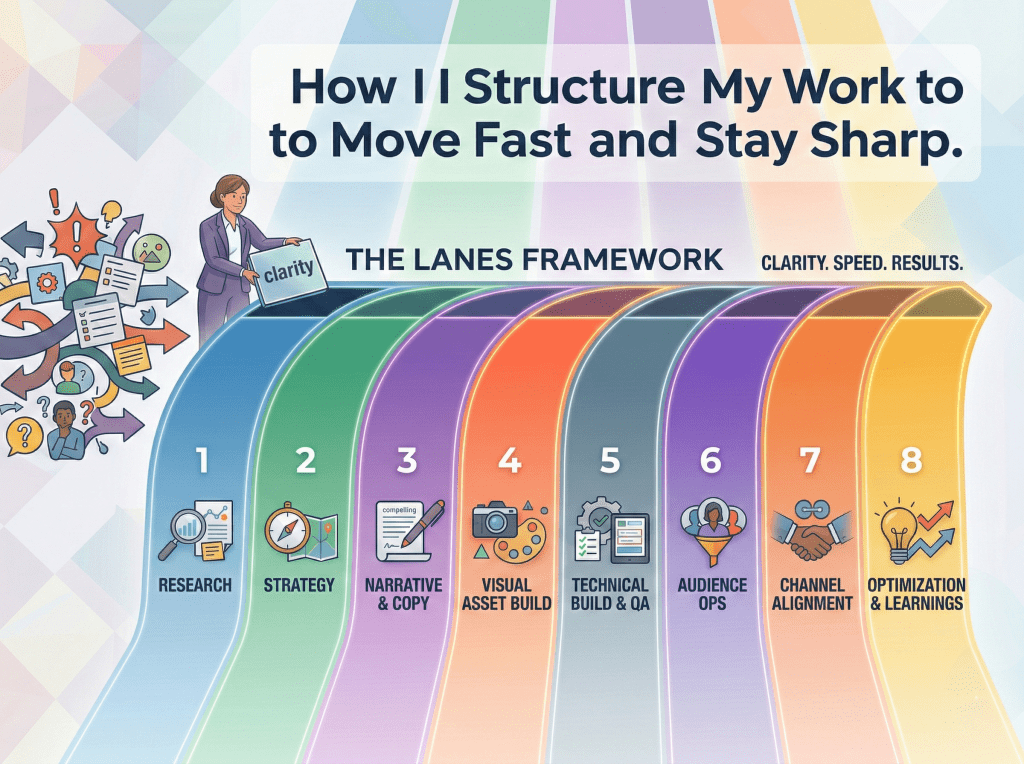
When you step into a new marketing role, the first few weeks are less about executing and more about orienting. What’s owned by whom? What does “good” look like here? Which requests reflect real priorities and which ones are just loud?
One concept has helped me answer those questions faster and work better as a result: lanes.
Not “stay in your lane” as a constraint. Lanes as a framework for clarity, a shared understanding of what each part of the work is responsible for and what it needs to move forward cleanly.
This matters most in roles where scope is broad by design. In lean marketing teams, one person often spans research, strategy, copywriting, design, email campaign build, list management, and channel alignment. That breadth is a real advantage. It creates end-to-end visibility most teams don’t have. But without structure, breadth turns into noise.
Why lanes matter
Without defined lanes, three predictable problems show up.
First, context switching becomes the default mode. Moving between high-level strategy and technical campaign configuration without a clear transition creates mental drag and slows delivery.
Second, quality issues get misdiagnosed. A weak email often isn’t a copy problem. It’s a strategy or audience problem that surfaced downstream, and without lane clarity, you fix the wrong thing.
Third, urgency becomes the prioritization system. The loudest request wins, even when it’s not the highest-impact work.
Lanes solve this by making it easier to say yes quickly, no cleanly, and “not yet” with a plan.
The 8 lanes I use
Each lane answers a specific question and provides a clear output. Even when one person is running multiple lanes, treating them as distinct stages makes execution cleaner and results easier to repeat.

Lane 1: Research What is true and what constraints exist? Market context, partner feedback, competitive notes, past performance. The output is clarity, not a deck.
Lane 2: Strategy What are we choosing and why? Objectives, targeting, messaging direction, channel selection, success metrics. Strategy prevents random acts of marketing. The output is a focused plan with clear milestones, so stakeholders can stay aligned without needing daily back-and-forth.

Lane 3: Narrative and copy What are we saying and how does it land? Email copy, landing page structure, social content, one-pager language, talk tracks. Good copy moves people from interest to action.

Lane 4: Visual asset build What do people see and what do they do next? Creative should reduce friction, increase comprehension, and make the next step obvious.
Lane 5: Technical build and QA Is it built correctly and measurable? Email setup, templates, UTM tracking, suppression logic, workflows, rendering checks, test sends. Small details here create big downstream consequences if skipped.
Lane 6: Audience operations Who receives this and why? Segmentation, data hygiene, list growth, keeping audiences clean and current. This lane is often the difference between a campaign that went out and one that reached the right profile.
Lane 7: Channel alignment How does this support how partners actually sell? Enablement alignment, distribution considerations, co-marketing workflows, and making sure the campaign connects to real outcomes, not just engagement.

Lane 8: Optimization and learnings What did we learn and what changes next cycle? Performance review, iteration decisions, and a short list of what we carry forward so every campaign makes the next one faster.
The part that makes it work: clean handoffs
Lanes only work if the handoffs between them are defined. A handoff is the minimum information required for the next lane to begin without looping back.
Strategy provides the goal, target audience, message direction, and success metrics before copy begins. Copy provides final subject lines, body, CTA, and any required legal language before design starts. Design provides final assets and specs before the email build begins. Audience operations confirms segment rules and counts before launch. The campaign build provides test results and a tracking plan before send.
When handoffs are defined, execution stops looping. You avoid the trap of starting work with missing inputs, then spending days chasing the clarity you needed before you began.
Running this in a lean role
If you’re one person covering multiple lanes, the goal isn’t to pretend you’re seven people. The goal is to run the work like a system.
Work in batches instead of constant mode-switching. Set expectations early about what you need before starting and what “done” means. Document decisions lightly so you’re not re-deciding the same things every campaign. Build templates for repeatable work so execution gets faster, not just familiar.
Breadth across lanes is a genuine advantage. This framework just makes sure that breadth operates as leverage, not as an undifferentiated pile of equally urgent tasks.
The takeaway
Lanes are not about control. They are about clarity and speed.
When the work has defined lanes and clean handoffs, teams move faster, quality issues surface earlier, and it becomes easier to protect the high-impact work from the noise.
If you’re running a broad role right now, the most useful thing you can do is make the lanes visible, not to justify workload, but to make the work more predictable and the outcomes more consistent.
Clarity makes everything else easier.




 My Ethos Lab