
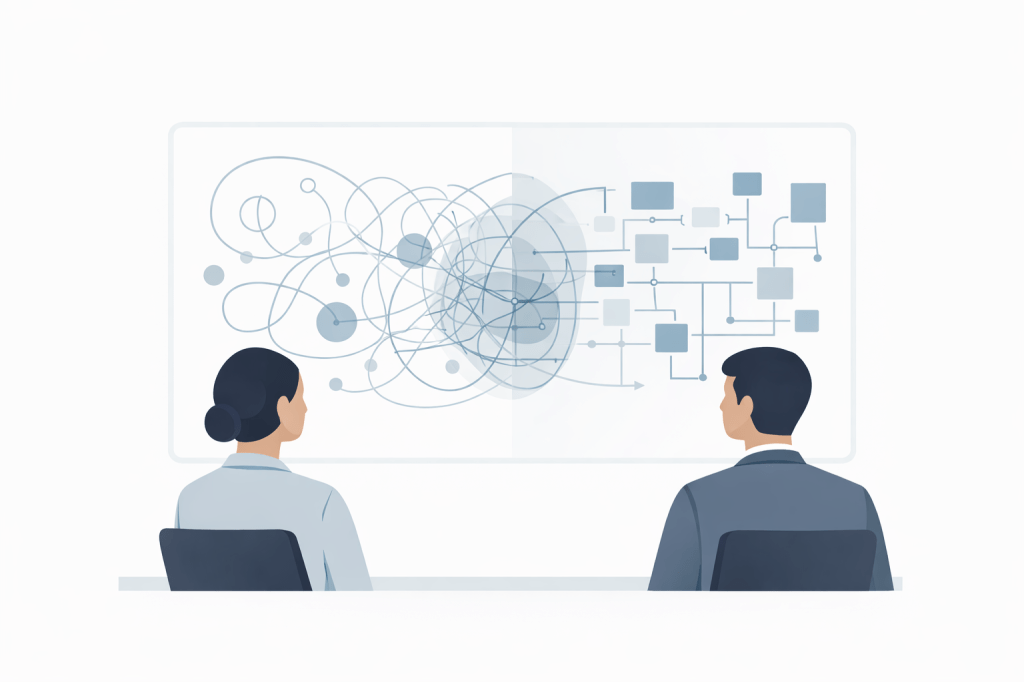
After a while, you start noticing that the hardest part of work is usually not the work itself. It is how different people move through the same problem.
I have worked with people who think out loud, people who need time to process before they say a word, people who want to pressure test every angle, and people who want a decision fast so the team can move. Early on, it is easy to label those differences the wrong way. You read silence as disengagement. You read fast verbal processing as a lack of structure. You read caution as resistance, and you read speed as recklessness.
But a lot of the time, none of that is true. What looks like friction is often just a mismatch in team communication styles.
The Mismatch in Action
People operate on different internal systems. They take in information differently, process risk differently, and reach clarity in different ways. Once you see that, a lot of workplace tension starts making more sense.
Give two people the same brief and you can watch this play out in real time. One person starts talking immediately, circling the issue and building the answer as they speak. The other goes quiet, disappears for a day or two, then comes back with a sharp, fully structured response.
Neither one is wrong. But if the first person assumes silence means lack of interest, or the second person assumes real-time processing means chaos, both people leave with the wrong read.
The same thing happens in planning. One person (the Explorer) is still widening the frame to find risks, while the other (the Planner) has already picked a path and is working backward from the deadline. Both are strategic necessities, but if nobody names that difference, the meeting turns into a loop. The explorer keeps opening doors the planner already closed, and the planner keeps pushing forward before the risks feel fully worked through.
The Practical Unlock: Naming the Difference
What changed for me was learning to spot those patterns sooner. I stopped treating other people’s style as a character issue. More importantly, I got better at adjusting how I communicate depending on who is in the room.
The real “unlock” is naming the operating system in the moment. It sounds like this:
- “I’m in ‘Explorer’ mode right now to make sure we aren’t missing a blind spot, but I know we need to pivot to ‘Planning’ in ten minutes.”
- “I know you need time to process this. Let’s skip the instant feedback and sync tomorrow morning instead.”
If someone thinks out loud, I do not expect a clean answer in the meeting. I listen for direction, not polish. If someone needs to see the first operational step before they can buy into the bigger vision, I start there.
Better Signal Reading
A team where everyone thinks the same way is not efficient: it is fragile. You need people who move fast and people who slow the room down. You need people who can spot risk and people who can keep things from stalling. You need different working styles because sameness creates blind spots.
The goal is not perfect harmony. It is better signal reading. The teams that work best are not the ones with no friction. They are the ones that learn how to interpret each other accurately. They stop mistaking difference for disrespect, silence for lack of contribution, and questions for resistance.
That is where better collaboration starts.
 My Ethos Lab